Concert Reviews: Season 2025-26
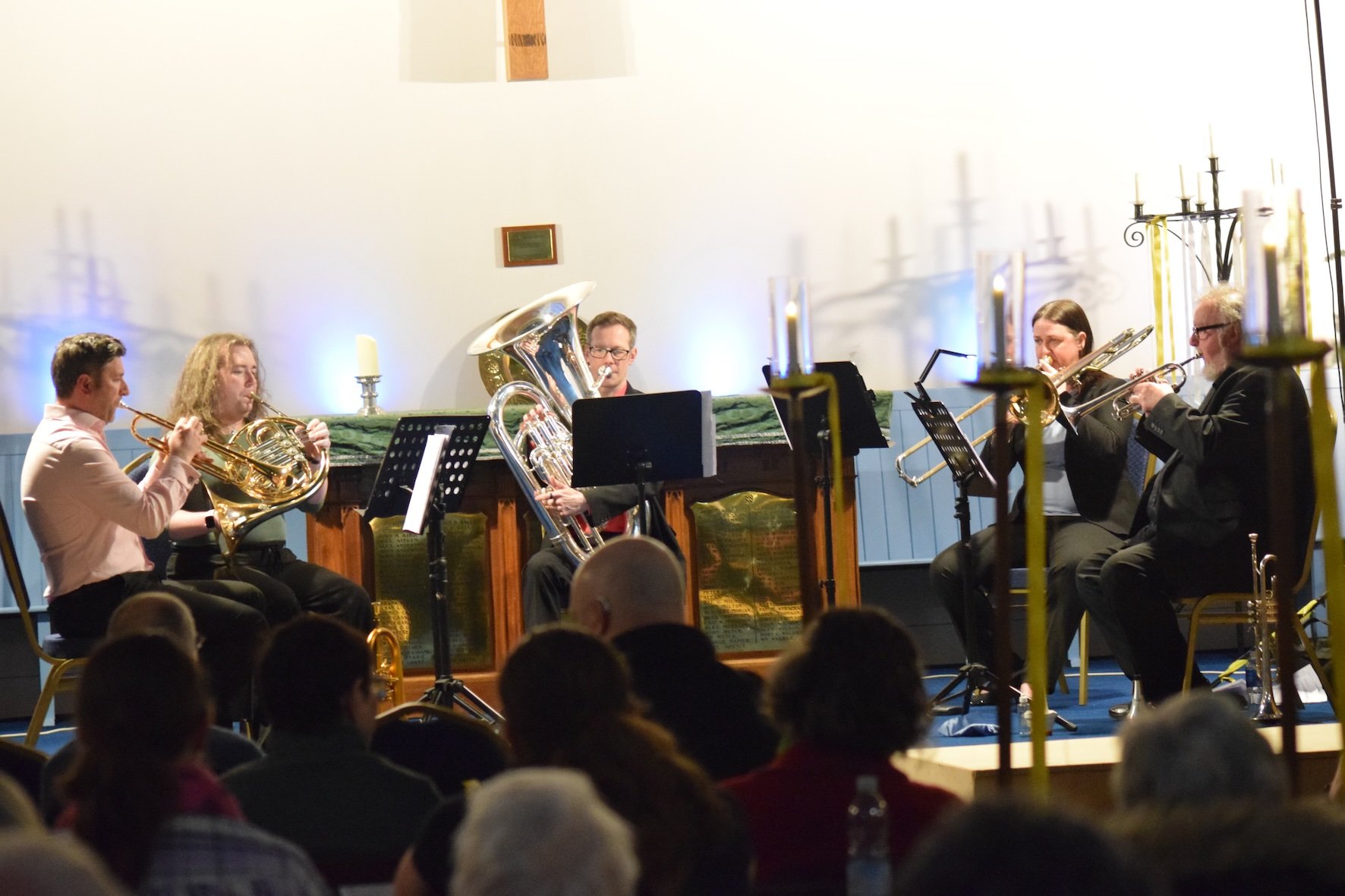
Review – Brass Tracks, St Andrew’s Church, Inverurie, 11 April 2026
And so another Inverurie Music concert series comes to an end: a series that began with the sultry sounds of the saxophone, moved to the virtuosity of the Romantic piano, Rhapsody in Blue on the wind quintet, guitar tangos, lesser known piano trios and finished in St Andrew’s Church with a brass fanfare to a large audience ready for some festivities. And this is what they got! The brass quintet, Brass Tracks, brought a varied programme of popular pieces that had more than a whiff of ‘Last Night of the Proms’ to it, as folk tunes and hits from the musicals rubbed shoulders with some more earnest offerings in an enjoyable night in the Garioch.
There were some interesting pieces on display from the quintet, showing the whole spectrum of music-making from simple arrangements to more challenging and bespoke works. The two short pieces by Austrian composer Nico Samitz were well performed and it was nice to hear some works written especially for a brass quintet amidst a flurry of arrangements and transcriptions. It was something of a shame that these pieces weren’t a bit longer, or more developed, giving the Inverurie audience a little more to get their ears around in this smörgåsbord of periods, styles and approaches. The combination of traditional tunes Wild Mountain Thyme and Loch Lomond by the ensemble’s horn player Robert Newth made for a pleasing addition, as did legendary conductor Elgar Howarth’s Four Swiss Tunes (with a memorable off-stage horn no doubt alluding to the famous Alphorn). Arrangements of Bizet’s suite from Carmen and The Beatles’s When I’m Sixty-Four rattled by in an idiomatic fashion with some nice characterisation from the players.
The second half of the concert was much like the first, with a more substantial piece (in this case Alan Fernie’s Three Scottish Dances) surrounded by more well-known arrangements from a variety of different genres. Of these, some worked better than others, and it might have been nice to have had more original pieces to give real variety. The half opened with an arrangement of Pastime with Good Company, written by Henry VIII, which showed just how effective brass instruments are when playing renaissance music – it was a shame that there wasn’t more of this repertoire to let these instruments really sing. The same applied to Bach on brass, which worked surprisingly well, but was too short to really embed these instruments in the acoustic.
The programme was nicely introduced by the players (though it was a shame we didn’t get to hear from the trombone player) with an obvious passion for the music and for their connections to the locality. The programme certainly gave a colourful end to the season, but there was a nagging feeling the Inverurie audience might have appreciated some music with a little more depth and challenge in places – something substantial on which to hang the more ephemeral offerings. The quintet played with gusto but not always precision and there were moments when the sound produced didn’t fill the sonorous acoustic of St Andrew’s as might have been expected. But this didn’t prevent it being an entertaining evening and ensuring a festive end to another wonderful Inverurie Music season.
PAC

Review – Chiara Trio, Acorn Centre, Inverurie, 07 March 2026
After the sun-soaked guitar virtuosity of Craig Ogden, it was a return to chamber music and to the resplendent acoustics of the Acorn Centre for the penultimate concert of the season. It was nice to welcome back the Chiara Trio to the Garioch after their fine performance in the 2023-24 season, an exciting programme of Bridge, Brahms, Debussy and McDowall which delighted the audience. This time the young trio brought some of the heavyweights of classical music, but not necessarily the most well-known works by these behemoths, but certainly plenty for a sizeable Inverurie audience to get their ears around.
The concert began with a sparkling Piano Trio by Haydn (HOB XV:28), full of the lightness, humour and sophistication one might expect from the Austrian master. The allusions to folk song in the opening movement kept the trio on their toes and there was some fine interplay between the musicians, obviously at home in this characterful music. The ensemble shaped the music well, even in the quirky finale with its shifts of key and material. This was followed by an early Piano Trio by Beethoven (Op 1, No 3), written when the composer was in his mid-twenties. It was interesting to hear the nascent Beethoven, writing in his characteristic key of C minor but without the trauma and burden of his later years. A little like the Haydn, the music swerved between keys and moods, but this seemed to suit the trio who dealt with every crossroads and cul-de-sac in this vibrant music.
The second half of the concert began with something less traditional, the evocatively titled When the Footbridge is Gone, I will Cross the River by Lithuanian composer Loreta Narvilaitė (1965 - ). Introduced in a clear and confident way by compatriot Chiara Trio pianist Elzė Fedorcovaitė, this was music that appeared to grow from the smallest seeds into something full of drama, colour and depth. Much like the classical pieces from the first half, the trio threw themselves at the work with gusto and precision, searching for all the nuances in this quixotic music. It was a lovely counterpoint to what came before and after. The concert ended with Dvořák’s Piano Trio No 3, a piece arguably less well-known than his others in this medium. After the classical effervescence of Haydn and Beethoven and the thorny postmodernism of Narvilaitė it was effective programming to finish off proceedings with a substantial piece of the romantic repertory. The trio were on top form in this piece, obviously enjoying the rich textures and expressive gestures and creating a powerful sound. It was a thrilling way to bring this concert to an end.
And before we know it, the final concert of the 2025-26 season is upon us, with acclaimed brass ensemble Brass Tracks coming to St Andrew’s Church on Saturday 11 April for a programme ranging from Bach and Bizet to McCartney and Henry VIII. Not everyday you get to write that.
PAC
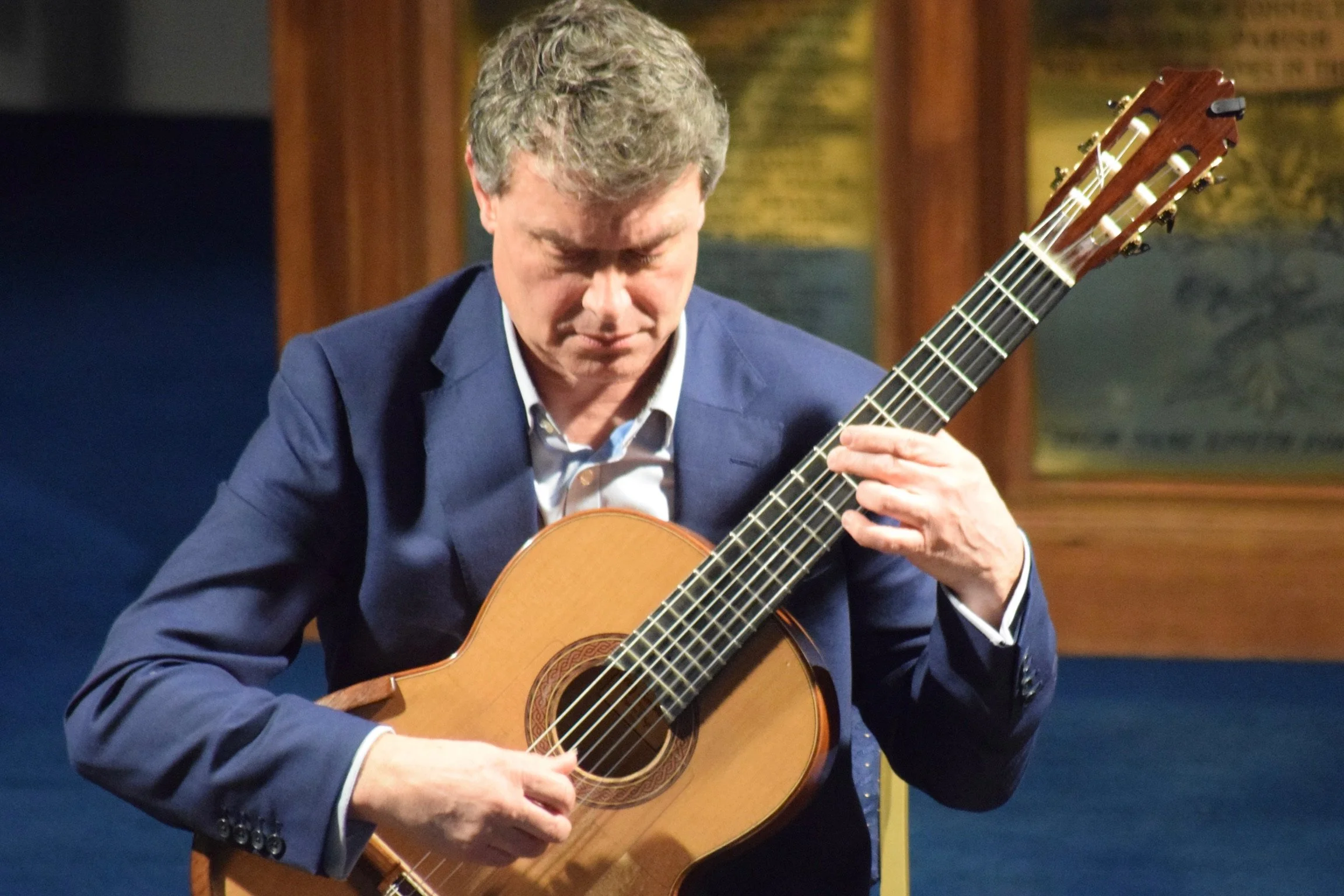
Review – Craig Ogden, St Andrew’s Church, Inverurie, 14 February 2026
Aberdeenshire had made the national news the Thursday before this concert but unfortunately not for any reason that the locals would like to broadcast - there had been no sight of the sun for over three weeks! The most desperate and grey winter in recent years finally decided to grant the most welcome shards of sunlight just in time for the visit of guitar virtuoso Craig Ogden to the county, a parting of the clouds to shine benevolence on our Australian maestro. And what better way to enhance those weak and wan winter rays than the sunniest of instruments, the classical guitar, famed as it is for music of more Mediterranean climes. Ogden certainly delivered: a mixed programme of core guitar repertoire, some colourful contemporary pieces and some sympathetic arrangements, all tinged with warmth and radiance to brighten our sun-starved lives.
St Andrew’s Church proved to be a wonderful setting for this performance, the perfect acoustic and atmosphere for the guitar, Ogden raised on a slight dais, an intimate semicircle of aficionados around him leading into a full house of eager audience in the main body of the church. The recital began in Spain with two pieces from Federico Moreno Torroba, one of the leading guitarist-composers of the mid-twentieth century, famed for his compositions for Andrés Segovia amongst others. These powerful, idiomatic pieces were the perfect introduction to the concert and the instrument, delivered with poise and perfection from Ogden. Other than the expressive playing, one of the highlights of the evening was the guitarist’s obvious ease with an audience, explaining the idiosyncrasies of the instrument and the background to the repertoire with charming aplomb. And there were some very funny anecdotes as well.
The remainder of the first half of the concert moved to France, Germany, Argentina and back beginning with a characterful piece from Napoléon Coste entitled Le Depart (sadly not about the French going on their summer holidays) before a beautiful rendition of Bach’s Prelude, Fugue & Allegro, a piece that sounds just as impressive on guitar as it does on harpsichord. The Atlantic was traversed for Astor Piazzolla’s Invierno Porteño, a depiction of an Argentine winter, but one much more varied and colourful than the endless greyness that has recently shrouded Aberdeenshire. The section finished in jubilant style with Roland Dyens’s ‘Fuoco’ from Libre Sonatina, a celebration of the composer’s return to health after a major operation and a moment of rhythmic vitality and showmanship, expertly navigated by Ogden.
The second half began with another Baroque master, this time Antonio Vivaldi, a composer also associated with the seasons (including a more vivid winter than contemporary events) and also with the guitar (or maybe that should actually beits forefather the lute). His concerto, in an arrangement by legendary guitarist John Williams, giving Ogden plenty of opportunity to show his abilities in shaping this deceptively difficult music. This was followed by the dramatic and spiky The Usher Waltz by Russian composer Nikita Koshkin and then a return to South America with Agustín Barrios’s Una Limosna por el Amor de Dios, one of the most beloved pieces in the guitar repertoire. The concert finished with a little ‘Gypsy Jazz’ from Django Reinhardt and three pieces from one of the most feted exponents of Spanish music, Joaquín Rodrigo (yes, he of that concerto fame) full of character and joy. Rapturous applause ensued from the large audience and Ogden reappeared for an effervescent encore, a further ray of light in this perfect antidote to the winter gloom.
PAC
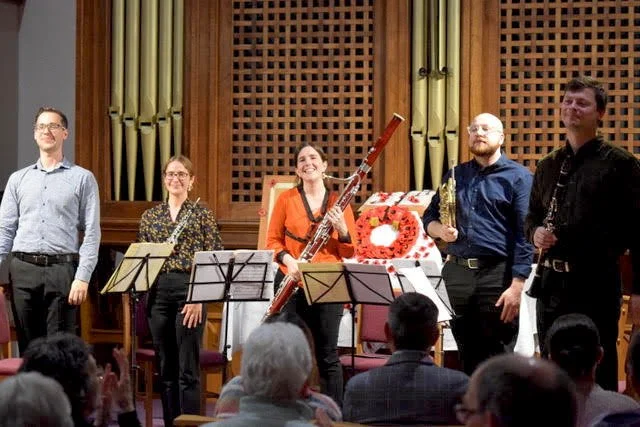
Review – Sirocco Winds, Acorn Centre, Inverurie, 08 November 2025
Following on from the pianistic pyrotechnics of Jonathan Mamora, it was time for something a bit lighter but no less technically assured – the second appearance in an Inverurie Music programme this calendar year of a wind quintet. A more playful cousin to the serious and sincere string quartet, the repertoire that has evolved along with the quintet is often lighter, brighter and quirkier than others, reflecting the five very different instruments that jostle together in this engaging ensemble. And it was wonderful to welcome such a fantastic exponent of this repertoire to Inverurie on a foggy autumn night, Sirocco Winds, fresh from navigating the choppy waters of island travel and safely ensconced in the warm acoustic of the Acorn Centre. They brought an exciting and varied programme that highlighted many of the different aspects of the wind quintet repertoire from characterful contemporary pieces to bespoke arrangements to romantic standards, all performed with poise, verve and humour.
The concert began in a stylish way with Ferenc Farkas’s Early Hungarian Dances, an arrangement made by the composer of earlier works in 1959. This beguiling set of pieces showed all the different characters of the wind quintet in fine fashion, finishing with a spirited dance that saw the music transcend its ‘provincial Hungarian Baroque style’ as the composer called it. If Farkas’s Early Hungarian Dances has been arranged by the composer for over seventeen different instrumental combinations, then there are very few arrangements of one of the staples of the twentieth-century piano repertoire, Ravel’s Tombeau de Couperin. But the Sirocco Winds turned in a performance that at times made the audience forget the French master’s pianism and listen to this wonderful music anew. Ravel arranged much of his piano music for orchestra, including this piece in 1919 (albeit without two of the movements), though it was still unusual to hear his music in such an unadorned manner. There was some beautiful playing throughout by the ensemble, the thinner textures leaving more space for the clarity of the instrumental lines. Tombeau de Couperin followed by Rhapsody in Blue is not an unusual combination in an orchestral concert but seeing it on a programme for wind quintet was perhaps a little more left field! The Gershwin was expertly introduced by the ensemble’s clarinettist, Calum Robertson (all the pieces were presented in an easy and knowledgeable fashion by the players), who explained in more detail the work’s famous clarinet introduction. It was a slightly disconcerting experience hearing this work, so famous and widely performed, in this stark way. Sometimes it felt like hearing a brand-new piece, sometimes like something half-heard and reminiscent. In either respect, the group gave a powerful performance, full of the energy and vigour this music demands.
The second half began with an equal amount of panache, Jim Parker’s Mississippi Five, the composer’s tribute to jazz greats from King Oliver to Bessie Smith. Parker’s work as a composer for television was never far from the surface, as the music was full of dramatic twists and turns, as well as adroitly proving a successful pastiche of a variety of jazz styles. The quintet obviously enjoyed the music greatly, as they gave a spirited performance across the five short movements. This was followed by two stately pieces of late-romantic chamber music: Amy Beach’s Pastorale and John Blackwood McEwen’s Under Northern Skies. Both found the quintet in more subdued demeanour, but no less expressive and assured in this music of great yearning and timelessness. The concert was finished with another arrangement, this time of Peter Maxwell Davies’s Orcadian rhapsody, Farewell to Stromness. This unprepossessing piano piece, part of a protest revue that Davies contributed to in 1980, was arranged with great feeling and empathy by the quintet’s flautist, Matthew Howells and provided a suitably apt way to end this very fine concert.
PAC
Review – Jonathan Mamora, Inverurie Town Hall, 20 September 2025
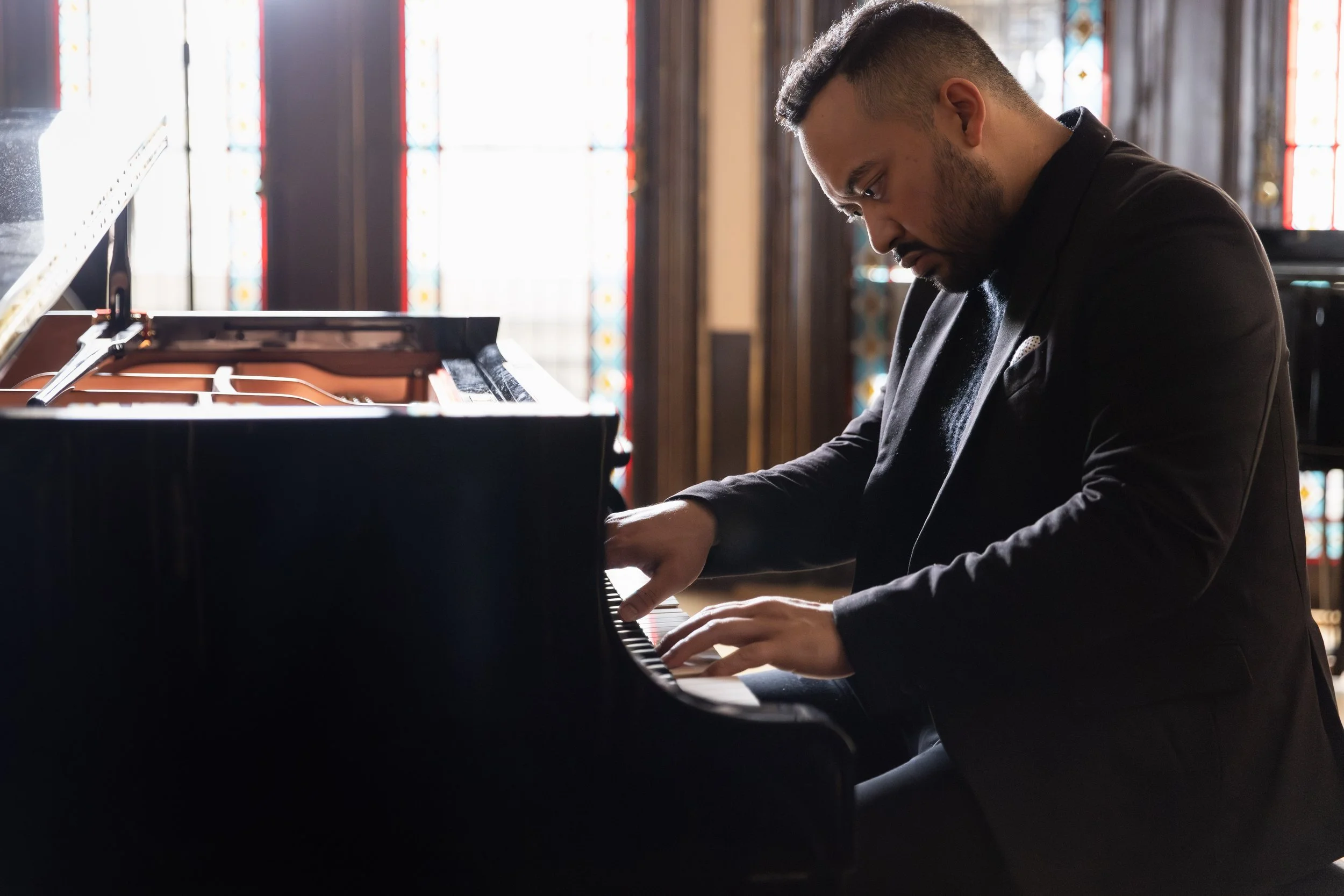
As the first fingers of autumn gradually felt their frigid way through the Garioch on this late September evening, it was only right that light and warmth should be generated by the second concert of the Inverurie Music season, and what a concert it was! Definitely something to banish any thoughts of short days and cold weather and to hint to the potential of an Indian summer. However sad the passing of summer might be, it does herald autumn’s gaudy finery with Bonfire Night being one of the season’s highlights – and fireworks were indeed on offer at the Inverurie Town Hall thanks to an amazing recital from celebrated pianist Jonathan Mamora.
A performer of international reputation, already well known to local audiences through winning the Scottish International Piano Competition in 2023 and performances of the Rachmaninoff Piano Concerto No 3 with the RSNO earlier this year, it was a great delight to welcome a musician of such calibre to Inverurie and to hear the Town Hall piano played with such gusto and precision. The concert began with Schumann’s beguiling and whimsical Arabesque, Op 18, music full of false starts and changes of direction that ends with a slowly dissolving meditation. Mamora took all these wanderings in his stride, seamlessly knitting together all of Schumann’s different fabrics with ease and poise. It was an extremely stylish way to begin. This was followed by a thoughtful introduction of the next piece by the pianist, someone who is obviously as comfortable talking about music as he is playing it. He had an instant relationship with the audience and the warmth generated by these interactions seeped into every crevice of the venerable building. The Schumann was followed by an exquisite Bach Toccata, not the F sharp minor as advertised, but the more filigree and optimistic D major with its compendium of Baroque traits and characteristics all perfectly realised by the pianist.
These more effervescent aperitives of the Austro-German repertoire were followed by music of a very different cast, much more questioning and intense and requiring profound concentration and impeccable technique from tonight’s performer. Again, Mamora’s skill at explaining the music to the audience was on show as Messiaen’s deeply personal and idiosyncratic ‘Le Baiser de l’enfant-Jésus’ from Vingt Regards sur l’enfant-Jésus was presented to the Inverurie audience. This is challenging music that begins with hypnotic repeated phrases but blooms into a kaleidoscopic exploration of every facet of the piano. Not only did Mamora cope with these technical challenges with aplomb, but he was a stirring advocate for an extremely difficult composition. He followed the Messiaen with an even more virtuosic feat of pianism, Scriabin’s Piano Sonata No 5, a piece that asks fundamental questions of the world, creativity and everything in between. It is also fiendishly difficult. A little like the Schumann, Mamora navigated the tempestuous, ever-changing waters of Scriabin’s single-movement masterpiece with dedication and verve – it was the highlight of the recital.
The second half of the concert was dedicated to one work, Rachmaninoff’s Piano Sonata No 2 in B flat minor, a staple of the repertoire but a piece not without its challenges and awkward corners. In another insightful introduction, Mamora explained the genesis of the piece and how the audience tonight would be treated to the earlier, longer version of the sonata, free from the pruning the composer did in later life. The pianist was obviously entirely at home with this repertoire and gave a thrilling and emotive performance of this poignantly melancholy late-romantic music. The audience responded in kind with much cheering and stomping, so it was no surprise to see Mamora return for a brief, but beautiful encore of Liszt’s transcription and elaboration of Schumann’s most heartfelt love song, Widmung. This is a favourite encore piece with many pianists, and it is not hard to see why with its softly mellifluous lines gently floating into the early autumn air. It was a spinetingling end to a truly memorable concert.
PAC